

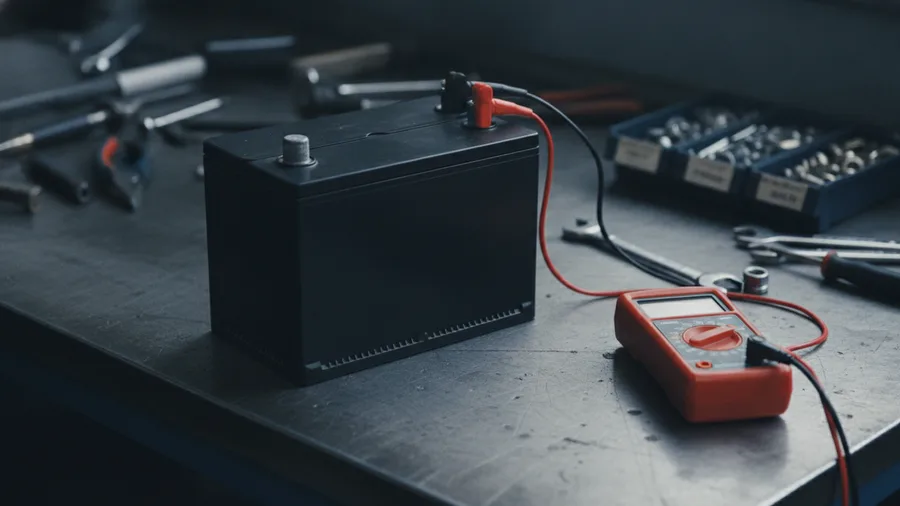
LVA15187 is an original-equipment part number for a 12-volt lead-acid starting battery fitted to compact and sub-compact utility tractors and similar small machines. It is widely cross-referenced to the group 22NF battery case size, so a replacement is normally chosen by matching the case size, terminal layout and cranking rating rather than by hunting for the part number itself.
Key facts
- What it is: the original manufacturer's part number for a 12 V lead-acid battery that starts the engine and runs the electrics on compact tractors and similar equipment.
- Case size: commonly cross-referenced to group 22NF, a compact case size used for lawn, garden and small tractor batteries.
- Cranking power: parts listings commonly quote about 500 cold cranking amps (CCA) and 600 cranking amps (CA). Confirm the figures on your own battery's label.
- Availability: the original number may have been superseded, so confirm the current part number from the machine's serial number in the original manufacturer's parts catalogue.
- Equivalents: any battery that matches the voltage, case size, terminal layout and polarity, and equals or exceeds the CCA rating, is a candidate replacement.
- Before fitting: check the date code and resting voltage, and confirm the hold-down and cables fit without strain.
In short, buying an LVA15187 replacement is a matching exercise. Read the label on the battery you are replacing, note the voltage, case size, cold cranking amps, chemistry and which corner the positive terminal sits in, then compare those details against each replacement on offer. Buy fresh stock from a supplier who can show the specification in writing, fit it with the negative cable disconnected first, and keep it charged whenever the machine stands idle. The same approach works whether you need one battery for a single tractor or dozens for a fleet.
What is the LVA15187 battery?
LVA15187 is a part number, not a battery standard. Equipment makers give every spare part a number in their own catalogue, and that number is printed on the battery fitted at the factory. When the battery eventually fails, owners and maintenance teams read the label, search for the number and find that very few sellers list it by name. That is why so many people search for the number on its own rather than for a description of the battery.
Behind the number is a conventional 12-volt lead-acid starting battery. Its job is to deliver a short, heavy burst of current to the starter motor, then supply the lights, instruments and controls while the alternator recharges it. Owners report that it fits the battery tray of several compact and sub-compact tractor models, and replacement listings almost always describe it in terms of the group 22NF case size.
Typical applications
- Compact and sub-compact utility tractors used on farms, estates, sports grounds and municipal sites.
- Similar small machines where a compact starting battery has to fit a tight tray.
- Equipment fleets that run several machines from the same maker and keep a common spare battery in stores.
If your machine is not on that list but the label still reads LVA15187, the advice in this guide still applies: the part number matters less than the specification printed beside it.
Why the part number can be hard to find
Manufacturers regularly supersede part numbers. A battery may be replaced in the catalogue by a newer number with a different construction, a higher rating or a different battery maker behind it. The old number then disappears from price lists even though many machines still carry it. The reliable way to confirm the current number is to look up the machine's serial number in the original manufacturer's parts catalogue or ask an authorised dealer. Treat any supersession as a prompt to recheck the specification, not as proof that the new battery is identical.
LVA15187 battery specifications and how to read the label
The table below sets out the details that matter when you replace this battery. The middle column shows what is commonly listed for this part number. The right-hand column tells you what to confirm, because the label on your own battery is the only source you can fully rely on.
CCA and CA explained
Cold cranking amps (CCA) is the current a fully charged 12-volt battery can deliver for 30 seconds at minus 18 °C (0 °F) while holding at least 7.2 volts. It is the best single measure of how well a battery will start an engine on a cold morning. Cranking amps (CA) is measured the same way at 0 °C (32 °F), so the CA figure is always higher than the CCA figure for the same battery.
Group 22NF batteries on the market vary noticeably in CCA from one product to the next. A lower figure may be acceptable in a mild climate, but in cold conditions, or on an engine that is slow to start, choose a replacement that matches or exceeds the original rating. A higher CCA does not harm the machine, because the starter only draws the current it needs.
Reading the label on the old battery
Before the old battery leaves the machine, photograph its label and top face. Record the part number, voltage, CCA, any CA or reserve capacity figure, the chemistry, the date code and the position of the positive terminal. That single photograph is the specification for your replacement and the evidence you will need if a supplier proposes an alternative.
LVA15187 cross reference: finding an equivalent battery
A cross reference is simply a list of batteries that meet the same specification. Rather than rely on a seller's claim that a product replaces LVA15187, check each candidate against the original yourself. Work through these points in order and reject any battery that fails one of them.
- Voltage. It must be a 12 V battery.
- Case size. It should be a group 22NF case, or a battery whose measured dimensions fit the tray with the hold-down closed.
- Terminal layout and polarity. The positive and negative terminals must sit in the same positions as on the original, otherwise the cables may not reach or may end up reversed.
- Terminal type. The posts or studs must accept your existing cable clamps.
- Cold cranking amps. The CCA should equal or exceed the figure on the original label.
- Chemistry. Flooded, sealed maintenance-free or AGM, chosen to suit the machine and how it is maintained.
- Documentation. The supplier should provide a data sheet that shows all of the above.
Original part or equivalent?
An original battery bought against the current part number removes any doubt about fit and may be required to keep a machine under warranty. An equivalent from a reputable battery maker is usually cheaper and easier to find, and owners frequently report that standard 22NF batteries drop straight into the tray. The right choice depends on the age of the machine, the warranty terms and how many units you need. For a fleet, it often makes sense to approve one equivalent after a short trial and then buy it consistently.
Flooded, maintenance-free or AGM?
Flooded batteries are the lowest-cost option, but they can need topping up with distilled water and must stay upright. Sealed maintenance-free batteries remove the topping up. AGM batteries hold their electrolyte in glass-mat separators, which makes them spill-resistant, more tolerant of vibration and better at holding charge in storage, at a higher price. Most machines charge all three types without trouble, but check the operator's manual if the machine has a specific recommendation.
How to source an LVA15187 replacement
For a single machine, the quickest route is usually a local equipment dealer or battery specialist. For workshops, estates, contractors and anyone maintaining several machines, a short competitive enquiry gives better prices, fresher stock and a written specification. The process follows the same steps as any request for quotation, which our complete guide to the RFQ sets out in detail.
What to include in your enquiry
- The part number LVA15187, plus "or equivalent" if you will accept an alternative.
- The specification from your label: 12 V, case size, CCA, chemistry and terminal layout.
- Quantity, delivery address and the date you need the batteries on site.
- Whether batteries must arrive charged and ready to fit, and the maximum age of stock you will accept.
- Warranty terms, and whether the supplier will collect old batteries for recycling.
- The documents you need, such as a data sheet and a safety data sheet.
On BSO you can submit an enquiry with these details once, and verified suppliers quote against the same specification, so prices can be compared like for like. Suppliers who stock industrial and equipment batteries can browse open enquiries and respond with a quotation.
Checking the supplier
Batteries are a common target for relabelled or out-of-date stock. Ask where the batteries were made, how long they have been in the supplier's stock and how they are stored. A supplier who sells to industrial buyers should be able to provide a data sheet, a written warranty and a clear returns process. Our checklist for finding and verifying industrial suppliers covers the wider due-diligence steps.
Shipping lead-acid batteries
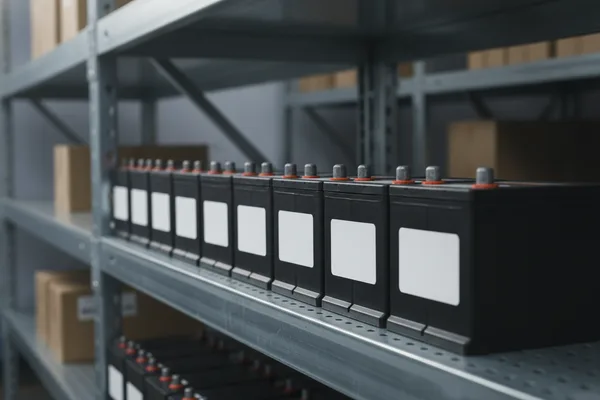
Lead-acid batteries are regulated for transport. Spillable (flooded) batteries are classed as dangerous goods under UN2794, while non-spillable types such as AGM batteries fall under UN2800 and can qualify for exemptions when they are tested and packed to the rules. Either way, batteries must travel upright with their terminals protected against short circuits. If you are moving a pallet of batteries between sites or across borders, tell the carrier exactly what is being shipped. You can publish the shipment on the logistics board so that carriers quote with the classification in mind.
Checks before you buy and when you fit
Confirm the old battery has actually failed
Slow cranking is not always the battery's fault. Charge the battery fully, let it rest for a few hours and measure the voltage across the terminals with a multimeter. A healthy lead-acid battery at rest reads about 12.6 V or slightly more. If it falls well below that soon after charging, or collapses under a load test, it needs replacing. Then start the engine and measure again: a working charging system usually raises the voltage to roughly 13.5 to 14.5 V. If it does not, a new battery will soon go flat too, and the alternator, regulator or wiring needs attention first.
Incoming checks on a new battery
- Check the date code and reject stock that is older than you agreed.
- Measure the resting voltage. A reading below about 12.4 V means the battery should be charged before it is fitted or stored.
- Inspect the case for cracks, bulging, leaks or damaged terminals.
- Compare the label with your specification: voltage, CCA, case size and terminal layout.
Fitting the replacement safely
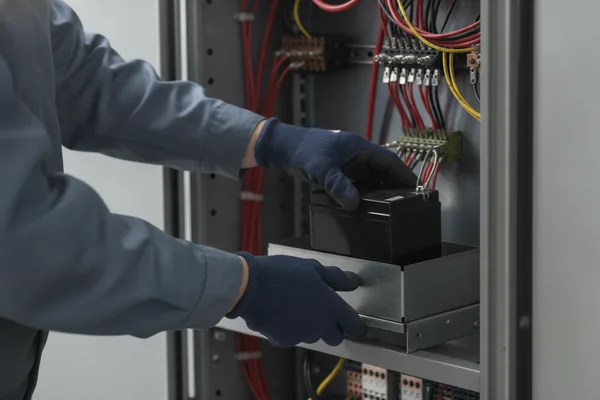
- Switch off the machine, remove the key, and wear eye protection and gloves.
- Disconnect the negative cable first, then the positive.
- Release the hold-down and lift the old battery out with care; even a compact lead-acid battery is heavy.
- Clean the tray and cable clamps, and replace any clamps that are badly corroded.
- Fit the new battery the same way round, secure the hold-down, then connect the positive cable first and the negative last.
- Apply terminal protection, refit any covers and check that the machine starts and charges normally.
Return the old battery for recycling. Lead-acid batteries must not go into general waste, and most battery sellers will take them back.
How to make a replacement battery last
Battery life depends far more on how the battery is charged and stored than on who made it. Compact tractors and grounds equipment often stand idle for weeks at a time, and that is when most batteries are damaged.
- Keep it charged. A lead-acid battery left partly discharged forms hard sulphate crystals on its plates that permanently reduce capacity. Use a maintenance charger on machines that stand idle.
- Protect it from cold. A fully charged battery resists freezing, but a flat battery can freeze and crack in a hard frost.
- Avoid heat. High temperatures speed up internal corrosion and self-discharge. Store spare batteries somewhere cool and dry.
- Avoid deep discharge. Running lights or accessories with the engine off drains a starting battery, which is not designed for repeated deep cycling.
- Keep terminals clean and tight. Corrosion and loose clamps cause poor starting that is easily mistaken for a failing battery.
- Follow the manual. The original manufacturer's maintenance guidance covers inspection intervals and charging limits for your machine.
Signs a battery needs replacing
Watch for slow or laboured cranking, a battery that will not hold charge overnight, a swollen or cracked case, heavy corrosion around the terminals, or a flooded battery that keeps needing water. Any one of these is a reason to test the battery. Two or more usually mean it is time to order the replacement before the machine fails at a busy time.
Managing spare batteries in stores
If you keep spares for a fleet, rotate stock so the oldest batteries are issued first, record the date each one was received and check the resting voltage every few months. Recharge any battery that has dropped below about 12.4 V. A spare battery that sits flat on a shelf for a season can be ruined before it is ever fitted.
Next steps
To replace an LVA15187 battery with confidence, start from the label on the old one, use that specification to build your own cross reference, and buy fresh, documented stock from a supplier you have checked. For larger or recurring orders, treat batteries like any other maintenance spare and include them in a planned buying cycle; our guide to the procurement process for industrial buyers shows how.
To see how enquiries, quotations and delivery fit together on one platform, read how BSO works. Suppliers who want to quote on battery and spare-part enquiries regularly can compare the subscription plans, and if you have a question about a specific requirement, contact the BSO team.
Frequently asked questions
An equivalent is any 12 V lead-acid battery that fits the same tray, has the positive and negative terminals in the same positions and offers at least the same cold cranking amps as the original. The LVA15187 is commonly cross-referenced to the group 22NF case size, so most equivalents are 22NF batteries, but always compare the label on your old battery with the replacement's data sheet before you buy.
The LVA15187 is commonly cross-referenced to the group 22NF case size, a compact size used for lawn, garden and small tractor batteries. Case dimensions can vary slightly between battery makers, so measure the length, width and height of your old battery and the tray, and confirm that the hold-down closes over the replacement.
Parts listings commonly quote the LVA15187 at about 500 cold cranking amps and 600 cranking amps. Treat those figures as a starting point and read the label on your own battery, then choose a replacement that equals or exceeds its CCA rating, especially if the machine works in cold weather.
Switch the machine off, wear gloves and eye protection, and disconnect the negative cable first, then the positive. Lift the old battery out, clean the tray and clamps, fit the new battery the same way round and secure the hold-down. Connect the positive cable first and the negative last, then recycle the old battery through the seller or a licensed collection point.
A lead-acid starting battery that is kept charged typically lasts several years, and owners report much longer service from well-maintained units. Life is shortened by long idle periods without charging, deep discharge, heat and loose or corroded terminals. Using a maintenance charger on machines that stand idle is the most effective way to extend it.
Write a short specification from the original label, including voltage, case size, CCA, chemistry and terminal layout, and state the quantity, delivery site, maximum stock age and warranty you need. Send the same enquiry to several suppliers, or publish it once on BSO so verified suppliers quote on the same basis, then compare total delivered cost rather than unit price alone.
Try it with a real enquiry
Verified suppliers quote within days. Free for buyers.