
AI petrol supply chain management is the use of machine learning, optimisation and automation to plan how petrol, diesel and other fuels are bought, stored, moved and delivered, from the refinery or import terminal to depots, filling stations and industrial customers. In practice it means software that forecasts demand, watches tank levels, schedules trucks, scores supplier risk and reads documents, so planners spend their time on decisions instead of spreadsheets.
Key facts
- Where AI helps most: demand forecasting, tank-level and inventory planning, routing and fleet scheduling, supplier risk scoring, purchase timing, predictive maintenance and document handling.
- Petroleum supply chain stages: upstream (crude production), midstream (pipelines, ships and storage terminals) and downstream (refining, distribution, retail and commercial delivery).
- What it needs: a clean history of sales or consumption, tank readings, deliveries, truck and depot data, supplier records and prices, with the same site and product codes everywhere.
- Best first project: one decision that is made often and measured clearly, such as when to refill a group of tanks or how to load tomorrow's trucks.
- Main limits: poor data, sudden market shocks, safety rules that software must never override, and models that drift when conditions change.
- How to judge it: fewer run-outs and emergency deliveries, lower forecast error, more litres delivered per truck shift and less time spent keying paperwork.
In short, AI is not a single system you switch on. It is a set of tools, each attached to one planning decision in the fuel chain, and each only as good as the data behind it. Start where decisions are frequent and data already exists, usually forecasting and tank replenishment. Run the model alongside your planners before letting it act, and keep people in charge of safety, contracts and anything unusual. Measure the result against a clear baseline, then extend to routing, supplier risk and procurement.
What is AI petrol supply chain management?
The petroleum supply chain moves a hazardous, price-sensitive product through a long series of handovers. Crude oil is produced, shipped by pipeline or tanker, refined into petrol, diesel, jet fuel and other products, stored at terminals and depots, then delivered by road tanker, rail or pipeline to filling stations, fleets, farms, factories and power sites. Every handover involves a measurement, a document and a decision about timing.
Traditional planning runs on fixed rules: refill a tank below a set level, repeat the same delivery rounds, buy on the same terms every month. Those rules waste money when demand shifts with weather, holidays, harvests or projects. AI petrol supply chain management solutions improve or replace these rules with models that learn from history and current data. Three kinds of technology do most of the work:
- Machine learning finds patterns in demand, delivery times and equipment behaviour.
- Optimisation chooses the best plan within hard limits such as truck capacity, driving hours and depot opening times.
- Language models read and draft documents, emails and reports, and answer planners' questions in plain language.
This guide focuses on the downstream end, where most distributors and fuel buyers feel the benefit. For how operators buy services and move equipment upstream, see our guide to oil and gas logistics and procurement.
Where AI is applied in the petroleum supply chain
Seven applications cover most real projects. Each solves a specific planning problem, and each can be started on its own.
Demand forecasting
Forecasting is the base for almost everything else. A model predicts how many litres each site, product or customer will use per day or week, using sales or consumption history together with drivers such as the day of the week, holidays, weather, local events, price changes and, for industrial users, production plans. Good forecasts are made at the level where decisions are made: per tank and product for replenishment, per depot for stock and truck planning.
Two habits make forecasts useful. First, give a range, not a single number, so planners know how much buffer to hold. Second, track forecast error every week against the simple method it replaces. A model that cannot beat "the same week last year, adjusted for the trend" is not ready to use.
Inventory and tank-level optimisation
Many tanks now report their level automatically through gauges and telemetry. AI turns those readings into a predicted run-out date for each tank and a recommended delivery date and quantity. Take a 30,000-litre tank that must not be drawn below 3,000 litres, holding 12,000 litres and using 2,500 litres a day: it has 9,000 usable litres, or about 3.6 days. If a delivery takes two days to arrange, the order should go in today, and a model that knows tomorrow is a busy holiday will bring it forward further.
Under vendor-managed inventory, the supplier watches the customer's tanks and decides when to deliver. Here AI helps fill trucks fully and avoid small, costly drops while keeping every tank above its safety level. Terminals and depots use the same logic, with stock that must also cover tank cleaning and the gaps between ship or pipeline arrivals.

Routing and fleet scheduling
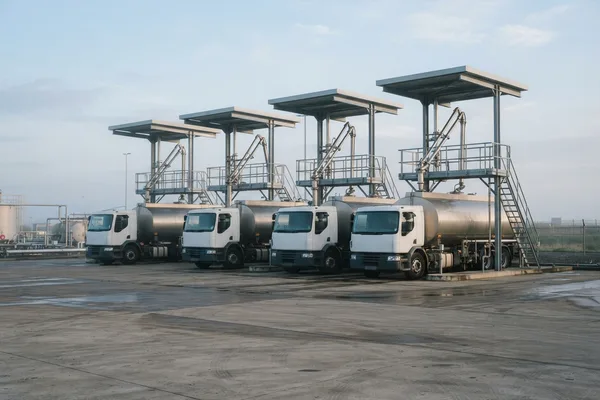
Fuel delivery is a tightly constrained scheduling problem. Each truck has compartments of fixed sizes, each compartment carries one product at a time, drivers have legal hours, depots have loading slots, and customers have delivery windows and site rules. Optimisation software builds daily plans within those limits and replans when a truck breaks down or an urgent order arrives. AI adds better estimates of travel and unloading times, learned from past trips, and predicts which deliveries are likely to run late.
The gains usually come from fewer part loads, fewer empty kilometres and fewer emergency runs. Dangerous goods rules, route restrictions and site safety procedures stay fixed inputs: the model plans around them, never through them.
Supplier risk scoring
Buyers of fuel, and of the equipment and services around it, need to know which suppliers are likely to deliver on time, to specification and in full. A risk score combines delivery and quality history, complaints, financial and ownership checks, certificate expiry dates, and outside signals such as port congestion. The score does not replace due diligence; it tells a buyer where to look first. Our guide on how to find and verify industrial suppliers covers the checks a score should be built on.
Price and procurement timing
Fuel prices follow crude markets, refining margins, exchange rates, taxes and local supply, and no model predicts them reliably beyond the short term. What AI does well is narrower: track your purchase price against a published benchmark, flag a quote that is out of line with recent ones, and suggest how to spread purchases so you are not exposed to a single day's price. Contract choices, hedging and fixed or index-linked pricing remain decisions for people with clear authority and limits.
Predictive maintenance of supply assets
Pumps, compressors, loading arms, meters, valves and tank trucks often show the first signs of failure in their data: vibration, temperature, pressure, flow, motor current or meter drift. Predictive maintenance models learn the normal pattern of each asset and warn when it changes, so work can be planned before a failure stops a loading bay or a delivery round. A warning only helps if the spare part is available when it comes; our guide to spare parts logistics explains how to stock them.
Document and compliance automation
Every fuel movement creates paperwork: bills of lading, delivery tickets, certificates of quality and quantity, dangerous goods documents, customs and excise records, tank calibration records and invoices. Document readers and language models can extract the key fields, match them against the order and the meter reading, and flag differences in volume, temperature-corrected quantity, product grade or price. Staff then review the exceptions instead of keying every document. The rule is simple: the system flags and drafts, and a named person approves anything that goes to a customer, a regulator or a payment.
What data AI needs
Most AI projects in fuel supply chains stall on data, not on models. Before choosing software, check what you already hold, how clean it is and who owns it.
Three basics matter more than any algorithm: one code for each site, tank, product and supplier, used in every system; timestamps in one time zone; and a named person responsible for keeping each data set correct.
How to start small
Trying to change the whole supply chain at once is the quickest way to waste an AI budget. A small, measured pilot proves the value and builds trust with planners.
- Pick one decision: for example, replenishment for 50 customer tanks, or next-day loading at one depot.
- Measure the baseline: run-outs, emergency deliveries, average drop size, forecast error and planner hours over the last three to six months.
- Fix the data for that scope only: correct the tank tables, fill the gaps and agree the codes.
- Try simple methods first: a well-tuned rule or a statistical forecast sometimes delivers most of the benefit and sets the bar for any model.
- Run in shadow mode: the model recommends, the planners decide, and both are recorded for four to eight weeks.
- Compare and decide: keep the model only if it beats the baseline on the agreed measures, then let it act within set limits.
- Extend step by step: add more sites, then a second use case that reuses the same data, such as routing after forecasting.
Agree in advance who can override the system and how overrides are recorded. Overrides are useful data: if planners keep changing the same kind of recommendation, the model is missing something they know.
Pitfalls and limits
- Bad data in, confident errors out: a forecast built on a wrong tank table looks precise and is wrong every day.
- Shocks break history: supply disruptions, sudden price moves or a large new customer make past patterns a poor guide. Models need closer monitoring and human judgement in those periods.
- Safety is not a trade-off: minimum tank levels, product segregation, driving hours and dangerous goods rules are hard limits, not targets to balance against cost.
- Black boxes lose trust: planners ignore recommendations they cannot understand. Choose tools that show the reasons behind each suggestion.
- Price forecasting is oversold: treat any claim to predict fuel prices months ahead with caution, and never let a model commit spend without limits.
- Cyber and access risk: connecting tank gauges, terminals and trucks to software widens the attack surface. Limit access, log changes and keep manual fallbacks.
- Lock-in: make sure you can export your data and the model outputs if you change provider.
Measuring results
Agree a short set of measures before the pilot starts and report them every month against the baseline.
How a procurement platform with AI assistance fits
Forecasting and scheduling tools tell you what you need and when. You still need suppliers to quote, transport to move the goods and people to run the operation. A procurement platform handles that side: it collects requirements, reaches suppliers, compares quotes and keeps the records together. On BSO:
- Buyers submit an enquiry with the specification, quantity and delivery location for the equipment, parts or services they need, then either let the BSO team source and consolidate quotes or publish it to verified suppliers and compare their quotes directly.
- Suppliers browse open enquiries and quote on the requirements that match their products.
- Transport needs go out as logistics enquiries, so providers can quote on land, sea and air freight for the same order.
- Employers looking for drivers, planners or terminal staff, and people looking for those roles, can use the jobs board.
Depending on your plan, the platform's built-in AI assistant can answer questions about your enquiries and orders and compare the quotes you receive side by side, explaining the differences. The figures come from the quotes themselves, and any change the assistant proposes waits for your approval. Read how BSO works for each step, and our RFQ guide for writing a request that suppliers can price accurately.
AI in the fuel supply chain: checklist
- List the planning decisions you make every day or week, and what each costs when it goes wrong.
- Pick one with good data and a clear measure.
- Clean the data for that scope and record a baseline over at least three months.
- Test a simple method first, then a model, in shadow mode.
- Write down the hard limits: safety levels, segregation, driving hours and spend authority.
- Choose tools that explain their recommendations and let you export your data.
- Review the measures monthly and extend only what works.
Next steps
AI earns its place in the petroleum supply chain one decision at a time: better forecasts, fuller trucks, fewer run-outs and less paperwork, each proved against a baseline. Start with the data you already have, keep people in charge of safety and contracts, and build from there. For the wider buying cycle around these tools, see the procurement process steps and our guide to procurement management software. If you supply or transport products for the energy sector, compare the subscription plans to start quoting on enquiries, and if you have a question about a specific requirement, contact the BSO team.
Frequently asked questions
It is the use of machine learning, optimisation and automation to plan how petrol and other fuels are bought, stored, moved and delivered. Typical uses are demand forecasting, tank-level monitoring and replenishment, truck routing, supplier risk scoring, purchase timing, predictive maintenance and reading delivery documents. The software recommends, and people stay responsible for safety, contracts and exceptions.
The petroleum supply chain has three main stages. Upstream covers exploration and crude oil production. Midstream covers moving and storing crude and products by pipeline, ship, rail and terminal. Downstream covers refining crude into petrol, diesel and other products, then distributing them through depots and road tankers to filling stations, fleets and industrial customers.
Oil supply chain management is the planning and control of how crude oil and refined products are sourced, stored, transported and delivered, together with the equipment, services and spare parts that keep the chain running. It covers procurement, inventory, logistics, scheduling, quality and documents, with the aim of meeting demand safely at the lowest total cost.
AI is used to forecast demand, predict tank run-out dates, plan truck and shipment schedules, score supplier and delivery risk, flag unusual prices or quotes, predict equipment failures from sensor data, and extract information from documents such as bills of lading and certificates of quality. Each use solves one planning problem and depends on clean, consistent data.
Not reliably beyond the short term. Fuel prices depend on crude markets, refining margins, exchange rates, taxes and local supply, and sudden events break historical patterns. AI is more useful for comparing your prices with a benchmark, spotting quotes that are out of line and spreading purchases to reduce exposure. Hedging and contract decisions should stay with people who have clear authority and limits.
Start with one frequent decision that has good data and a clear measure, such as replenishing a group of tanks. Record a baseline for three to six months, clean the data for that scope, and test a simple method and then a model in shadow mode alongside your planners. Keep the model only if it beats the baseline, then extend to more sites or a second use case.
Try it with a real enquiry
Verified suppliers quote within days. Free for buyers.